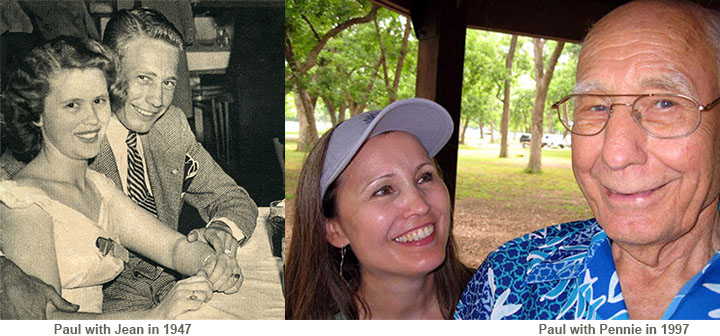
In 1958, Paul made 85 cents an hour working in a limestone quarry in Oklahoma.
He was a man of character, integrity, and kindness.
He was quiet, smiled a lot, and was a wonderful listener.
Paul’s humility, kindness, and confidence gave him dignity and authority in the eyes of everyone who knew him.
He was happily married and had three little girls. On the day his fourth little girl was born he walked into a storm that could easily have ripped him apart.
It was with great heaviness of heart that Doctor Franklin told him that there was a problem with the Rh factor in the little girl’s blood and that she was almost certainly going to die.
She was barely, barely, barely hanging on.
With tears in his eyes Doctor Franklin told him, “And your wife is also fading fast.” Doctor Franklin dropped his chin to his chest as teardrops splashed on his shoes.
An ambulance rushed both mother and daughter to a larger hospital in a larger town.
Paul was all alone with eighty-five cents an hour and three little girls.
Several hours later, a happy and rejoicing Doc Franklin told Paul that both mother and daughter were going to live!
They were going to live.
The medical bill was more than a thousand dollars and there was no insurance; just a husband and wife and four little girls and 85 cents an hour.
Being a man of integrity, Paul went to see Doc Franklin the next day to set up a payment plan for paying that thousand-dollar medical bill.
Doc Franklin said, “What medical bill?”
Paul was confused, and it showed on his face.
Old Doctor Franklin spoke plainly,
“There is no medical bill. You do not owe any money. Just be a good father to those girls.”
“Just be a good father to those girls.”
I can testify that he was a good father to those girls. I met Paul Compton when I was 14 years old and in love with his daughter, the one who nearly died on the day she was born.
Here’s how I met him.
One week prior to beginning my freshman year in high school, my mother received an invitation to come to an open house at the school on a Tuesday night where she could meet Coach Jerry Meeks, my home room teacher.
He taught Oklahoma History, of course.
Attached to that letter was a list of all the other students who would be in my first-hour class.
I saw that Pennie Compton was going to be in that class with me. She knew who I was, but we had never actually met. This would be the first time that we would be in class together.
Mom couldn’t go that night, which suited me fine. I had a plan of my own.
I was the first person to arrive. The parking lot was empty except for the cars of the teachers. I met Coach Meeks, then took a seat at a desk in the back row. About 30 minutes later, a tall man came walking in with his wife and the girl that I knew I was going to marry.
After Paul and his wife exchanged pleasantries with Coach Meeks, I walked up to him, introduced myself, then shook his hand as I smiled and said,
“My name is Roy Williams and you’re going to be seeing a lot of me.”
Last week Princess Pennie and I celebrated our 49th wedding anniversary.
Paul never criticized me or gave me advice unless I asked for it. But when I did ask for it, he would tell what he thought, along with some true stories from his own life that explained why he believed what he believed.
He always spoke slowly and gave me his full attention. His confidence in me was a great encouragement.
In all the decades that I knew Paul Compton, I never saw him raise his head from prayer without having tears on his cheeks. When Paul talked to God, you knew that God was listening.
I always looked forward to having him pray for me.
He was the best man I ever knew.
Roy H. Williams
Monica Ballard knows why marketing campaigns fail. It’s not for lack of clever slogans, talented spokespeople, or catchy jingles. Monica says ad people fail when they try to project “perfection” rather than authenticity, which requires that you acknowledge the struggles and risks inherent in running a business. Monica is a veteran marketing strategist, storyteller, and one of the elite Wizard of Ads partners.
 Drawing on her background in theater, radio, and live performance, Monica explains to roving reporter Rotbart and deputy rover Maxwell why empathy and emotional honesty create bonds with customers that no discount or gimmick ever could. “Being real isn’t a liability,” Monica assures us. “It is a decisive competitive advantage.” Get Real with Monica Ballard at MondayMorningRadio.com