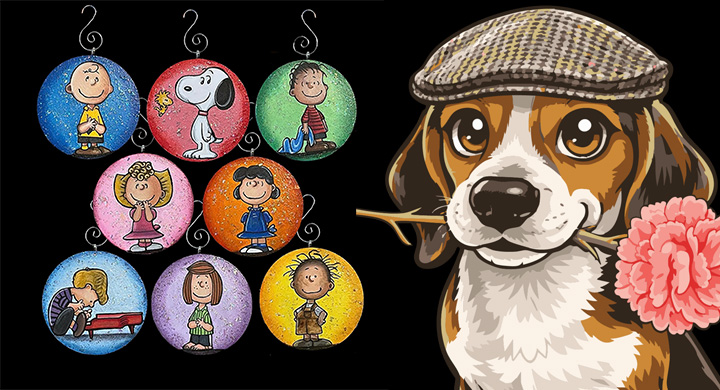
In a screening room at network headquarters in New York, two CBS vice presidents watched a television show in silence. Neither of them laughed once. When the lights came on, the executives shook their heads and shrugged.
“Well,” said one, “you gave it a good try.”
“It seems a little flat,” said the other.
“Too slow,” said the first, “and the script is too innocent.”
“The Bible thing scares us,” said the other.’
“The animation was crude — couldn’t it be jazzed up a bit?”
“The voice talent was unprofessional — they should have used adults.”
“The music didn’t fit — who ever heard of a jazz score on an animated special?”
“And where were the laughs?”
The show they were discussing was, “A Charlie Brown Christmas,” the most successful special in television history.
The passage we just read can be found in a book called “Schulz and Peanuts: A Biography” by David Michael.
My friend Tom Grimes sent me a nostalgic note last week.
Indy Beagle and I rewrote Tom’s note to give it rhythm and make it rhyme, then we sent it out to a few million friends in 109 nations of the world, all of whom are familiar with the show and its characters.
This is what Tom’s note became:
Peanuts was not your typical children’s cartoon.
There were no villains. There were no goons.
Charles Schulz never talked down to his viewer.
Everything was innocent. No humor from the sewer.
It was dramedy about being human.
No one left behind like a Star Trek red-shirt crewman.
Schulz created a world of children and a pup,
characters we all knew when we were growing up.
Snoopy was a sensation, the coolest character in the nation,
A carefree beagle living in a world of his own imagination.
Charlie Brown was us and our fellow man,
A decent person doing the best that he can.
Sally was the little sister, innocent and adorable.
Anyone who did not like her was horrible.
Linus was the Best Friend, a philosopher with a blanky,
The kind of Best Friend that we all wanted to be.
Lucy was the older sister who did not think twice
but handed out insults disguised as free advice.
Schroeder was the talented child who played piano.
All he needed was someone who could sing soprano.
Peppermint Pattie was the independent one.
She did her own thing, but she was always fun.
Pig-Pen showed up only now and then.
He remained a mystery until the very end.
Snoopy was who we all wanted to be.
Charlie Brown was our reality.
Charles Schulz understood insecurity.
But the kids were normal, just like you and me.
Insecurity, disappointment, and occasional joy
was the daily world of every girl and boy.
But what lifted up every boy and girl
was the coolest jazz music in all the world.
the coolest jazz music in all the world…
the coolest jazz music in all the world…
the coolest jazz music in all the world.
The music you remember hearing in A Charlie Brown Christmas was written and recorded more than 60 years ago by the Vince Guaraldi Trio.
It was inducted into the Grammy Hall of Fame in 2007.
This year it became the best-selling jazz album of all time, certified six-time platinum by the Recording Industry Association of America.
Yes, A Charlie Brown Christmas has now officially surpassed that magical Miles Davis album, Kind of Blue.
Walmart, Target, Barnes and Noble, and Urban Outfitters have each released exclusive vinyl editions of A Charlie Brown Christmas and the Original Jazz Classics reissue is available pretty much everywhere.
2027 is going to be an extremely very interesting year.
Perhaps I will share my predictions next week.
Roy H. Williams
PS – You can see and hear Indy Beagle’s Youtube production of Tom’s note on the first page of the rabbit hole. To get there, just click the image of Indy Beagle at the top of the page of the Monday Morning Memo for November 23, 2026. You’ll find it in the archives at MondayMorningMemo.com.
Famous investigative journalist Gardiner Harris returns for Part Two of his conversation examining how one of America’s most admired corporations—Johnson & Johnson—has maintained its reputation despite decades of lawsuits, controversies, and allegations of wrongdoing.
 Harris explains the difference between protecting a company’s reputation, and earning the trust of its customers and employees.
He also offers unsettling advice about protecting ourselves from dangerous medications and medical devices, and explains how America’s troubled healthcare system imposes enormous financial burdens on small businesses.
Does your company’s public image reflect your actual practices? The answer could sharply affect your future. Join roving reporter Rotbart and deputy rover Maxwell for Part Two of this amazingly insightful 2-part series at MondayMorningRadio.com