• Home
  • Memo
    • Past Memo Archives
    • Podcast (iTunes)
    • RSS Feed
  • Roy H. Williams
    • Private Consulting
    • Public Speaking
    • Pendulum_Free_PDF
    • Sundown in Muskogee
    • Destinae, the Free the Beagle trilogy
    • People Stories
    • Stuff Roy Said
      • The Other Kind of Advertising
        • Business Personality Disorder PDF Download
        • The 10 Most Common Mistakes in Marketing
          • How to Build a Bridge to Millennials_PDF
          • The Secret of Customer Loyalty and Not Having to Discount
          • Roy’s Politics
    • Steinbeck’s Unfinished Quixote
  • Wizard of Ads Partners
  • Archives
  • More…
    • Steinbeck, Quixote and Me_Cervantes Society
    • Rabbit Hole
    • American Small Business Institute
    • How to Get and Hold Attention downloadable PDF
    • Wizard Academy
    • What’s the deal with
      Don Quixote?
    • Quixote Wasn’t Crazy
      • Privacy Policy
      • Will You Donate A Penny A Wedding to Bring Joy to People in Love?

The Monday Morning Memo

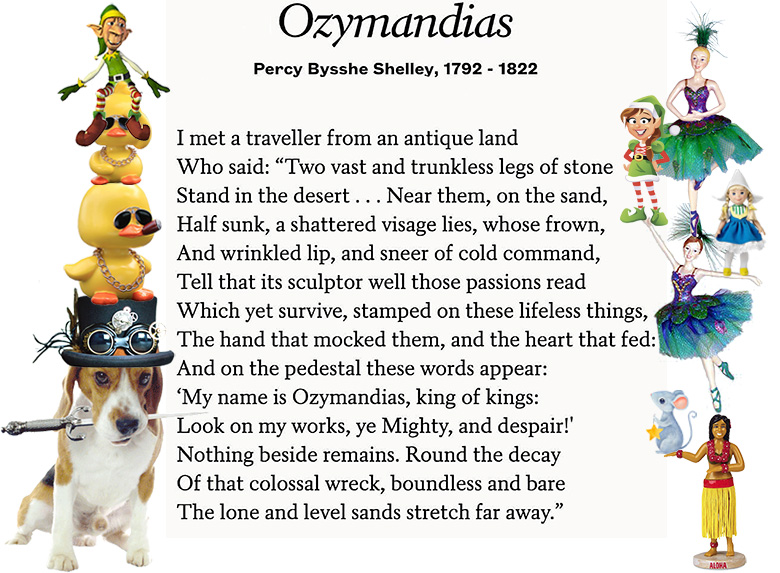
A few years ago, the busted-up statue of Ozymandias was found (video below) and it is now assembled in a museum in Memphis, Egypt (2nd video below).

Archaeologists believe eight-metre statue found in Cairo slum is of Pharaoh Ramses II, who ruled Egypt in 13th century BC. Ramses the Great or Ozymandias, ruled for 66 years, from 1279BC to 1213BC.

He led several military expeditions and expanded the Egyptian empire to stretch from Syria in the east to Nubia (northern Sudan) in the south. His successors called him the Great Ancestor.

Percy Bysshe Shelley’s 1818 sonnet Ozymandias – which contained the line “Look on my works, ye Mighty, and despair!” – was written soon after the British Museum acquired a large fragment of a statue of Ramses II from the 13th century BC.

“We found the bust of the statue and the lower part of the head and now we removed the head and we found the crown and the right ear and a fragment of the right eye,” Anani said of the new discovery.

Archaeologists believe eight-metre statue found in Cairo slum is of Pharaoh Ramses II, who ruled Egypt in 13th century BC.

Email Newsletter

Sign up to receive the Monday Morning Memo in your inbox!

Download the PDF "Dictionary of the Cognoscenti of Wizard Academy"

Random Quote:

“The detection of life elsewhere in the universe would be the greatest discovery of all time. Physics professor Enrico Fermi wondered why, given the age and vastness of the universe, and the presence of billions of stars and planets that have existed for billions of years, we have not yet been contacted by any other alien civilizations. This was his paradox.

Chatting with his colleagues over lunch in 1950, Fermi supposedly asked, ‘Where are they?’ our own galaxy contains billions of stars and there are billions of galaxies in the universe, so that is trillions of stars. If just a fraction of those anchored planets, that’s a lot of planets. If a fraction of those planets sheltered life, then there should be millions of civilizations out there. So why haven’t we seen them? Why haven’t they got in touch with us?

In 1961, Frank Drake wrote down an equation for the probability of a contactable alien civilization living on another planet in the Milky Way. This is known as the Drake equation. It tells us that there is a chance that we may coexist with another civilization but the probability is still quite uncertain. Carl Sagan once suggested that as many as a million alien civilizations could populate the Milky Way, but he later revised this down, and others since have estimated that the value is just one, namely humans.”

- Joanne Baker, Universe: 50 Ideas You Really Need to Know

The Wizard Trilogy

The Wizard Trilogy

More Information

  • Privacy Policy
  • Wizard Academy
  • Wizard Academy Press

Contact Us

512.295.5700
corrine@wizardofads.com

Address

16221 Crystal Hills Drive
Austin, TX 78737
512.295.5700

The MondayMorningMemo© of Roy H. Williams, The Wizard of Ads®