• Home
  • Memo
    • Past Memo Archives
    • Podcast (iTunes)
    • RSS Feed
  • Roy H. Williams
    • Private Consulting
    • Public Speaking
    • Pendulum_Free_PDF
    • Sundown in Muskogee
    • Destinae, the Free the Beagle trilogy
    • People Stories
    • Stuff Roy Said
      • The Other Kind of Advertising
        • Business Personality Disorder PDF Download
        • The 10 Most Common Mistakes in Marketing
          • How to Build a Bridge to Millennials_PDF
          • The Secret of Customer Loyalty and Not Having to Discount
          • Roy’s Politics
    • Steinbeck’s Unfinished Quixote
  • Wizard of Ads Partners
  • Archives
  • More…
    • Steinbeck, Quixote and Me_Cervantes Society
    • Rabbit Hole
    • American Small Business Institute
    • How to Get and Hold Attention downloadable PDF
    • Wizard Academy
    • What’s the deal with
      Don Quixote?
    • Quixote Wasn’t Crazy
      • Privacy Policy
      • Will You Donate A Penny A Wedding to Bring Joy to People in Love?

The Monday Morning Memo


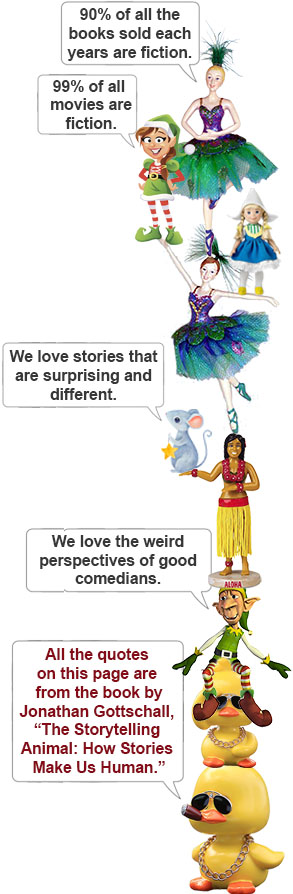
“Fiction seems to be more effective at changing beliefs than nonfiction, which is designed to persuade through argument and evidence. Studies show that when we read nonfiction, we read with our shields up. We are critical and skeptical. But when we are absorbed in a story, we drop our intellectual guard.”

“Like Tom Sawyer whitewashing the fence, authors trick readers into doing most of the imaginative work.”

“Fiction is an ancient virtual reality technology that specializes in simulating human problems.”

“Like a flight simulator, fiction projects us into intense simulations of problems that run parallel to those we face in reality. And like a flight simulator, the main virtue of fiction is that we have a rich experience and don’t die at the end.”

“Why do stories cluster around a few big themes, and why do they hew so closely to problem structure? Why are stories this way instead of all the other ways they could be? I think that problem structure reveals a major function of storytelling. It suggests that the human mind was shaped for story, so that it could be shaped by story.”

“We are, as a species, addicted to story. Even when the body goes to sleep, the mind stays up all night, telling itself stories.”

– Jonathan Gottschall

“The Storytelling Animal: How Stories Make us Human.”


Email Newsletter

Sign up to receive the Monday Morning Memo in your inbox!

Download the PDF "Dictionary of the Cognoscenti of Wizard Academy"

Random Quote:

“After Dorothy tries to tell her aunt and uncle about the unfortunate incident between the town spinster Miss Gulch and Dorothy’s dog Toto, an annoyed Aunt Em tells Dorothy to ‘find yourself a place where you won’t get into any trouble.’ Though Aunt Em is simply referring to an actual, physical place on the farm where Dorothy won’t get into trouble, as Dorothy reflects on this, she turns the real into the metaphorical, saying to Toto, ‘Some place where there isn’t any trouble. Do you suppose there is such a place, Toto? There must be. It’s not a place you can get to by a boat, or a train. It’s far, far away. Behind the moon, beyond the rain.’

This little scene elegantly creates a ‘bridge from one place to another’ from the reality of Dorothy’s Kansas farm to the world of her imagination, a world that comes to life with the first two notes of ‘Over the Rainbow.’

“In a musical language utterly different from the through-composed, non­-repetitive style of ‘Stormy Weather,’ ‘Over the Rainbow’ has only two melodic ideas in its famous opening. The first I will call ‘leap,’ and the sec­ond ‘circle-and-yearn.’ The full-octave leap on ‘somewhere’ is enormous for the opening of a popular song. It’s a leap between two different parts of the voice — and between two different worlds. The first note is low, almost in chest voice. It’s Dorothy’s troubled reality — Kansas, aridity, no flowers, the black and white of the opening of the film.

The second note is higher, lighter, and more ethereal. It’s ‘over the rainbow,’ Oz, the place she wants to escape to. The other melodic idea occurs in the second measure, on ‘over the rainbow.’ It begins on a B, circles back to a B, and then yearns upward to a C. These gestures — leap, and circle-and-yearn — are the two key musical ideas of the song.””

- Rob Kapilow, in his book "Listening for America."

The Wizard Trilogy

The Wizard Trilogy

More Information

  • Privacy Policy
  • Wizard Academy
  • Wizard Academy Press

Contact Us

512.295.5700
corrine@wizardofads.com

Address

16221 Crystal Hills Drive
Austin, TX 78737
512.295.5700

The MondayMorningMemo© of Roy H. Williams, The Wizard of Ads®